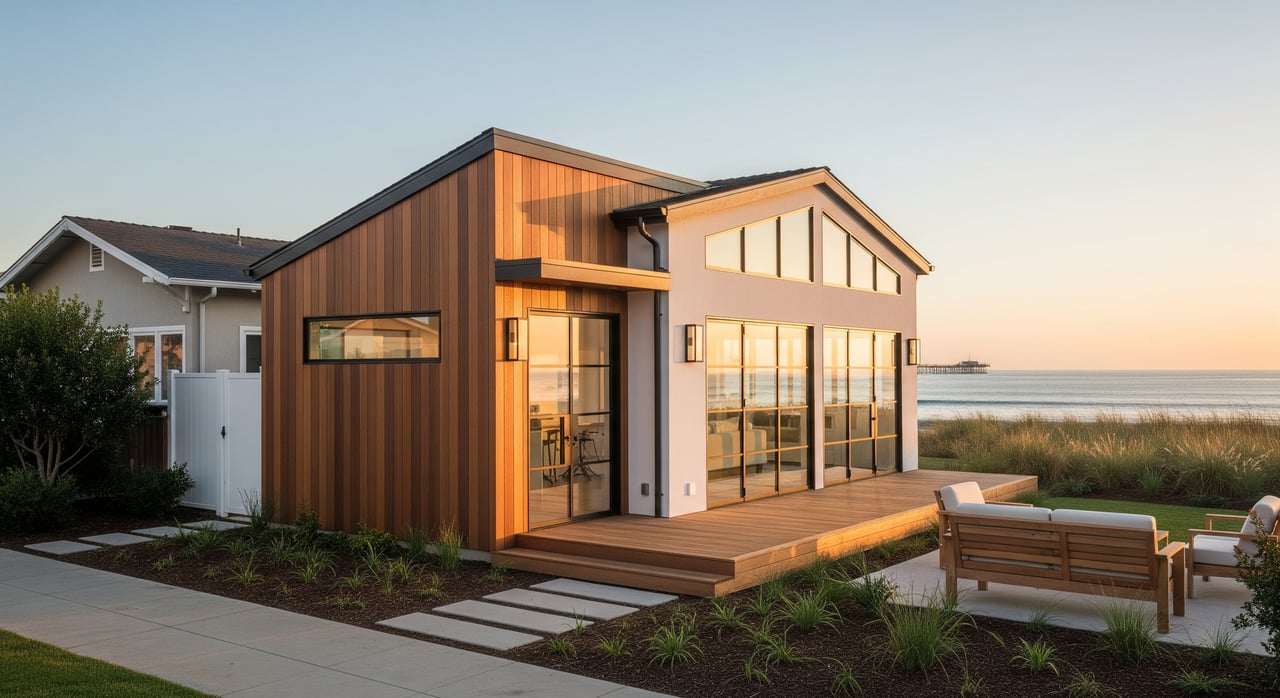
Thinking about building an ADU in Seal Beach to boost income or create flexible space for family? You are not alone. The coastal setting is a draw, but it also brings unique permitting steps you should plan for before you spend a dollar on design. In this guide, you will learn how ADUs are approved in California, what Seal Beach’s coastal status means for your timeline, how to size up rents and costs, and a simple framework to estimate ROI with confidence. Let’s dive in.
ADU ROI at a glance
Accessory dwelling units can add value in two ways: rental income and improved property utility. In California, ADUs are processed ministerially when you meet objective standards, which helps reduce uncertainty. In Seal Beach, coastal review can still apply, so timing and soft costs matter in your ROI.
- Aim for conservative rents and higher contingency. Coastal timing can stretch, which impacts carrying costs.
- Pick the right ADU type for your lot and goal. Conversions cost less than new detached units but may affect parking and layout.
- Start with feasibility. Confirm coastal status, setbacks, and utilities before modeling returns.
For an overview of state processing rules, review the California Department of Housing and Community Development’s ADU resources, which explain ministerial approval and timeframes under state law. You can start at the California HCD website for ADU guidance.
Seal Beach permitting basics
State rules you can count on
Under state law, cities must process ADU applications ministerially when they comply with objective standards. That means no discretionary hearing when your plans meet code and your submittal is complete. State rules also allow a range of ADU types: detached, attached, garage conversions, and Junior ADUs inside an existing single‑family home. For state context and FAQs, visit the HCD ADU page at the California HCD website.
Local realities you should check
Seal Beach is a coastal city. Much of it sits inside the California Coastal Zone. That is the key local variable because coastal consistency can add steps.
- Coastal Development Permit or LCP review. If your property is in the Coastal Zone and your project triggers review under the City’s Local Coastal Program, you may need a Coastal Development Permit or a consistency determination. Coastal review can add submittals and time. Learn about coastal permitting at the California Coastal Commission.
- Objective standards still apply. Even in the coastal zone, you will need to meet objective standards like setbacks, height, lot coverage, fire and life safety, and allowable sizes. Confirm any local caps, especially for detached units and in historic areas.
- ADU types. Junior ADUs (up to 500 square feet under state guidance), attached additions, detached cottages, and garage conversions are all possible paths. Choose based on budget, access, and site constraints.
For local planning questions and current fee schedules, contact the City through the City of Seal Beach website.
Coastal zone check
Your first step is to confirm if your parcel lies inside the Coastal Zone and whether your ADU triggers local coastal review. Coastal consistency can include visual, shoreline, or resource protection conditions. In some cases, appeals may bring the Coastal Commission into the process.
- Expect added time for CDP or LCP review. Build that into your underwriting.
- Know your site. Proximity to the beach, flood zones, or tsunami evacuation areas can influence design and cost. Elevated foundations or structural upgrades may be required in certain mapped areas.
Parking and utilities
Parking and utilities can make or break feasibility. State law limits local parking requirements, and many cities cannot require more than one off‑street space per ADU. Garage conversions often do not require replacement parking under state law, but you should confirm Seal Beach’s current practice.
- Parking. Verify whether your lot qualifies for any state parking exceptions based on proximity to transit or other criteria.
- Water, sewer, power. Ask Public Works about meter rules and connection fees. Some cities allow ADUs on the same meter, while others require separate meters. Sewer lateral capacity and connection fees can be meaningful line items.
- Access. Narrow lots and tight rear access can drive cost for construction logistics and may require fire access solutions.
Timeline and costs
Permitting timeline
- Ministerial ADUs. For a straightforward, complete application, plan for roughly 60 to 90 days for ministerial processing. Workload and completeness will influence this.
- Coastal review. A Coastal Development Permit or LCP review can add months, especially if appeals occur or if supplemental studies are needed.
- Building permits and plan check. Add weeks to months based on complexity and queue.
Build time
For a small detached ADU of roughly 400 to 800 square feet, plan for several months of construction once you break ground. Complex designs, site constraints, or contractor scheduling can extend that.
Fees and soft costs
Budget for building and plan check fees, potential coastal fees, utility connection or capacity fees, and design professionals. Plan for architect and engineering services, possible surveys or geotechnical work, and contingencies. Orange County construction costs tend to run higher than statewide averages, so get multiple local bids early and include a 10 to 20 percent contingency.
Research rents the right way
Rents in a beach market can swing by season and block. You should triangulate with multiple sources to avoid overbuilding.
- Pull long‑term rental comps by bed and bath count, square footage, and proximity to the beach. Talk to local property managers and review MLS listings and community boards.
- If you are considering short‑term rentals, confirm current City rules before assuming nightly rates. If allowed, compare occupancy and rates by season and then annualize.
- Track quality and amenities. Renovated interiors, private outdoor space, and parking access can influence rent. Use conservative numbers for underwriting.
Underwrite ROI step by step
Start simple and refine as you get firm quotes.
Step 1: Confirm legal feasibility
- Call Seal Beach Planning to verify your zoning, Coastal Zone status, overlays, and objective standards.
- Clarify allowable ADU types, sizes, setbacks, height, lot coverage, and parking rules. Ask about garage conversion treatment.
- Request a pre‑application or test‑fit review if available.
Step 2: Estimate project costs
- Hard costs. Site work, foundation, structure, roofing, windows and doors, interior finishes, HVAC, kitchen and bath, and utility connections.
- Soft costs. Plans, structural engineering, permit and inspection fees, possible coastal permit work, surveys, and contingencies.
- Financing and carry. Interest during construction, loan fees, and time‑based holding costs.
Step 3: Estimate income and expenses
- Potential gross rent. Build conservative and optimistic scenarios using current comps.
- Vacancy and collection. Use 5 to 10 percent for long‑term rentals as a planning range.
- Operating expenses. Maintenance, insurance, property management, owner‑paid utilities, HOA (if any), repairs and reserves. A planning ratio of 25 to 40 percent of gross rent is common for long‑term rentals.
- Property taxes. ADU improvements can change assessed value. Consult the County Assessor or a tax advisor on incremental assessment questions.
Step 4: Calculate returns
- Net Operating Income (NOI) = Gross Scheduled Rent × (1 − Vacancy) − Operating Expenses.
- Cash‑on‑Cash Return = Annual cash flow after debt service divided by total cash invested.
- Simple Payback = Total cash invested divided by annual cash flow after debt.
- Compare to market cap rates for context and consider IRR if modeling a hold and sale.
Hypothetical example template
Use the approach below as a fill‑in template. Replace every number with your real quotes and comps.
- Monthly rent assumption: $2,600 (conservative) or $2,900 (market). This is a placeholder for illustration.
- Gross annual rent: $2,600 × 12 = $31,200.
- Vacancy at 7 percent: $2,184. Effective gross income = $29,016.
- Operating expenses at 30 percent of gross: $9,360. NOI = $19,656.
- If financed, subtract annual debt service to get annual cash flow.
- Cash invested: down payment plus closing plus soft costs. Cash‑on‑Cash = annual cash flow divided by cash invested.
Label each number as an assumption and run at least three scenarios: conservative rent, market rent, and a higher construction cost case. Your goal is to see how sensitive cash flow is to time and cost.
Red flags to watch
- Coastal uncertainty. If a CDP or coastal conditions are likely, timeline and cost can increase.
- Site complexity. Narrow access, drainage, retaining walls, or foundation work can push budgets beyond planned contingencies.
- HOA or CC&Rs. Restrictions on design or rentals can limit your plan.
- Utilities. Separate meters or a significant sewer lateral upgrade can be large one‑time costs.
Quick feasibility checklist
- Confirm zoning and Coastal Zone status with Seal Beach Planning.
- Ask whether a Coastal Development Permit or LCP review is required.
- Check for historic overlays, easements, or HOA rules.
- Measure usable rear or side yard and verify construction access.
- Pull current rent comps from multiple sources and local managers.
- Get two to three contractor pre‑bids with itemized line items.
- Ask Public Works about meter rules, sewer capacity, and connection fees.
Your next steps
- Call Seal Beach Planning for a pre‑application conversation. Ask about coastal requirements and objective standards. 2) Engage an ADU designer to sketch options: Junior ADU, attached addition, detached unit, or a garage conversion. 3) Gather preliminary contractor pricing and a rough schedule. 4) Model at least three underwriting scenarios with conservative rents and longer timelines. 5) Choose financing and get quotes. 6) Move to full plans and a complete permit submittal when the numbers hold up.
If you want help pressure‑testing rents, understanding local buyer demand for homes with ADUs, or planning an exit strategy after completion, our team is here. We work coastal neighborhoods every day and bring a clear, data‑forward process so you can invest with confidence. Ready to put numbers to work or considering a sale after you build? Get a Free Home Valuation and connect with Kevin Sullivan.
FAQs
What does “ministerial approval” mean for a Seal Beach ADU?
- It means the City reviews your complete application against objective standards without a discretionary hearing, consistent with state ADU law and HCD guidance.
Do I need a Coastal Development Permit for my Seal Beach ADU?
- If your property is in the Coastal Zone and your project triggers review under the City’s Local Coastal Program, you may need a CDP or a consistency determination, which can add time and submittal items.
How long does it take to permit and build an ADU in Seal Beach?
- A straightforward ministerial submittal can take roughly 60 to 90 days, while coastal review can add months; construction for a small detached unit typically takes several months once underway.
How should I estimate rent for an ADU near the beach?
- Compare multiple comps of similar size, condition, and proximity to the beach and speak with local property managers; use conservative numbers and account for seasonality if short‑term rentals are allowed and considered.
Can I convert my garage to an ADU without replacing parking?
- State law significantly limits requirements for replacement parking in garage conversions, but you should confirm Seal Beach’s current rules and any local exceptions tied to transit proximity.
What utility and fee items often surprise ADU owners?
- Meter rules, sewer lateral capacity, connection and capacity fees, and coastal‑related fees can be meaningful costs; contact Public Works and Planning early to verify current requirements.
References: For state policy and FAQs, visit the California HCD website. For coastal permitting context, see the California Coastal Commission. For local processes and contacts, start at the City of Seal Beach website.